The danger isn't that AGI gets built. It's who holds the keys when it does — and that almost nobody outside the building knows.
Frontier labs publish papers about capabilities and safety, but stay strategically vague about their endgame: what they'd actually do the day they hold decisive technological advantage. That opacity is itself the risk. The argument, stated plainly:
AGI is decisive power
An intelligence that out-thinks humans in science, persuasion, cyber, and strategy is not just a product. Whoever directs it can reshape markets, militaries, and minds.
→Control is concentrated
At every lab, ultimate authority funnels to a tiny group — often one person with controlling votes, or a board with no public accountability.
→Power without a check is dystopia-shaped
Absolute power over a god-like tool, held privately and opaquely, is the precondition for permanent, unaccountable control. Good intentions don't fix a bad structure.
Map of the build-labs: who would own god, and through what mechanism.
Each card reads the same way: who has ultimate control, how concentrated that control is, and the legal lever that secures it. Click any lab to trace the full chain of command. Concentration scores are an editorial reading of public governance facts as of late 2025 / early 2026 — directional, not precise.
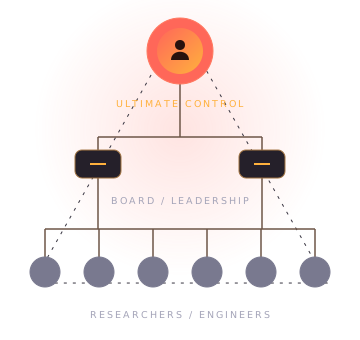
Strip away the logos and the same shape appears: a pyramid with almost no one at the top.
Different countries, different charters, identical concentration. The variable that matters is not who is nicest — it's whether anyone with the power to say "no" sits outside the founder's chain of loyalty.
“Through special voting and governance rights held solely by the OpenAI Foundation, the Foundation appoints all members of the board of directors of OpenAI Group and can replace directors at any time.”
The honest question: can decisive power be built without building a dystopia? Here's the menu of structures that might contain it.
None of these is sufficient alone. The serious proposals stack them — internal governance, plus national regulation, plus international verification — so that no single point of failure can capture the technology.
Independent oversight trusts
A body that can appoint and remove directors, holds no equity, and answers to the mission rather than shareholders. Anthropic's Long-Term Benefit Trust is the live experiment — its members now appoint a majority of the board.
International project ("CERN / Intelsat for AGI")
Build frontier AGI once, jointly, under multinational governance with shared infrastructure — so no single company or country owns the result outright.
Compute governance ("IAEA for AI")
Treat frontier compute like fissile material: chip registries, KYC for compute providers, verifiable FLOP caps, and inspections. The choke point that makes a global "pause button" technically enforceable.
Windfall & benefit-sharing clauses
Bind a lab in advance to distribute extreme upside broadly rather than to founders and early investors — converting "winner takes the lightcone" into a public good.
Hard national regulation
Licensing of frontier training runs, mandatory third-party evals, liability, and whistleblower protection — so the state, not the CEO, sets the floor on deployment.
Radical transparency
Force the long-term vision into the open: published control charts, succession plans, and "what we'd do at decisive advantage" commitments. Opacity is the edge — sunlight removes it.
No one has built a foundation that ultimately lets humanity decide its own fate.
Look back across every card. Not one of these structures hands the final decision to the people who would live with the consequences. They are all powers vying for control of the future — a founder, a board, a trust with a trapdoor, a state. The differences are real, but they are differences in who holds the keys, never in whether the keys are held privately.
They may call themselves incorruptible. But have we not learned, again and again, that absolute power corrupts absolutely?
Consider OpenAI. It was founded as a nonprofit explicitly so that no one could capture the upside of AGI. Then came a capped-profit arm. Then the cap came off. By 2025 it had restructured into a public-benefit corporation that can raise capital with no ceiling on investor returns — and twelve former employees filed a brief saying the company had abandoned its nonprofit roots. Sam Altman, briefly fired by his own safety-oriented board in 2023, returned and emerged with more control, not less. The founding tenets bent toward power — not because anyone was a villain, but because the structure permitted it.
If the most idealistic charter in the field can be re-papered in under a decade, then the safeguard was never the charter. The only real safeguard is putting the decision somewhere a single will cannot reach — and so far, no one has.
Every lab above shares one flaw: they ask you to trust the people at the top. Orgoneism asks for no trust at all. It is an organizational vehicle engineered to scale world-altering tech — AI, energy — while making domination mathematically impossible. It starts centralized to gather energy, then is structurally, legally, and economically forced to decentralize as it grows.
The Core
PHYSICS · BOSE–EINSTEIN CONDENSATEThe anchor of absolute, unchanging alignment.
The Engine
PHYSICS · CASIMIR ARRAYTaps the vacuum of global capitalism for kinetic energy — capital and talent — without being consumed by it.
Progressive Decentralization
PHYSICS · TOPOLOGICAL ERROR CORRECTIONHuman boards rot through ego and the domination glitch. You cannot trust humans to stay decentralized — you hardcode it into the legal physics.
The Kill Switch
OPEN-SOURCE FAILSAFEThe ultimate firewall against capture is the structural inability to keep a monopoly.
Build this vehicle and you've created a corporate entity that operates like reality's own firewall. It starts centralized to gather energy, but is structurally, legally, and economically incapable of domination. As it reaches maximum capability, it triggers a decentralized phase transition — dissolving its own central power and harmonizing with the entire human ecosystem.
It wins capitalism by making the physics of monopoly impossible.